Before you let someone supervise your riding, remember that you're allowed to interview them, too. Their experience doesn't cancel out your right to ask questions, set boundaries or walk away.
Recently, I was supervising a learner who wasn't entirely convinced she could manage an uphill turn in a cul-de-sac.
Fair enough, too. Uphill turns at low speed demand good coordination between the clutch, throttle and brakes. Add the fear of dropping the motorcycle, and something that looks relatively straightforward can become a pretty intimidating exercise.
We'd spent time working on her control skills, and I'd seen enough to believe she was capable. She wasn't quite so convinced.
So, with a little encouragement and a carefully measured challenge, we gave it a go.
She did it.
And afterward? A huge smile, a very happy learner, and a bit of good-natured grief directed at her instructor for making her do the uphill cul-de-sac.
But underneath the joking, I could hear the relief. I could see the change in her body language.
She'd discovered something about herself.
I hadn't given her confidence. I'd helped her find evidence that she was developing the skills to justify it.
I love moments like that.
The Conversations Before the Ride
I've recently had the pleasure of supervising several women who have impressed me with how quickly they've developed their riding skills.
Some arrived with considerable doubts about their abilities. Yet with a bit of guidance, practice and room to learn, their competence became increasingly obvious.
I've also noticed something interesting.
Before we get anywhere near a motorcycle, there's often a fairly thorough conversation.
We might start with a phone call or exchange a few messages. Then, when we meet, the questions continue.
What do I do for work? Why am I teaching riders? What's my riding background? What's my approach to safety?
Sometimes there's a bit of teasing thrown in, too.
I enjoy these conversations. I'm interested in the person I'm going to be riding with, their experience, their expectations and their attitude toward learning.
But I've come to appreciate that the conversation works both ways.
While I'm getting to know the learner, the learner is getting to know me.
They're interviewing the supervisor.
And they absolutely should be.
Trust Shouldn't Come Automatically With a Motorcycle Licence
I've heard some disappointing stories from women about their experiences trying to find suitable motorcycle supervision.
Some have described situations that made them uncomfortable. Others have received questionable advice or been taken on rides that offered little opportunity to develop the skills they actually needed.
I don't know how widespread these experiences are, and I'm certainly not suggesting that all male supervisors behave this way.
There are plenty of excellent supervisors out there, quietly helping people become better riders.
But the stories I've heard raise some important questions.
Nobody should have to tolerate inappropriate behaviour, unwanted attention or unnecessary risk simply because they need someone to supervise their riding.
When someone agrees to supervise a learner, whose needs are being met?
Is the ride organised around the learner's development, or around what the supervisor feels like doing?
Does the supervisor understand what the learner needs to practise?
And does the learner feel comfortable speaking up when something isn't right?
I'm a dad to an amazing daughter. She's capable, independent and quite capable of giving me a hard time when she thinks I deserve it.
I don't want her sheltered from every challenge. I want her equipped to recognise situations, make sound decisions and stand up for herself.
I'd want exactly the same for anyone learning to ride a motorcycle.
Male or female.
You're Allowed to Interview Your Supervisor
Here's something I think we should tell learner riders more often.
Before you let someone supervise your riding, remember that you're allowed to interview them, too. Their experience doesn't cancel out your right to ask questions, set boundaries or walk away.
Have a conversation before you commit to a ride.
Ask about their experience, their approach to safety and what they intend to do during your time together.
If you're preparing for your Q-Ride RE course, ask whether they can help you practise the relevant skills.
If you're struggling with slow-speed control, tell them that's what you want to work on.
If you're uncomfortable riding in a group, say so.
And if the answers don't sit right with you, you're allowed to find someone else.
You don't need a dramatic confrontation or an elaborate excuse.
A simple "Thanks, but I don't think this is what I'm looking for" will do.
You can also change your mind after you've started. If a situation becomes uncomfortable or unsafe, stop somewhere safe and reconsider the arrangement. You don't have to keep riding just to avoid disappointing someone.
Your learning experience belongs to you, too.
Being an Experienced Rider Doesn't Automatically Make You a Good Teacher
Here's where I might upset a few people.
Having years of riding experience doesn't necessarily mean you know how to teach someone to ride.
You might be a very capable motorcyclist but struggle to explain how to coordinate the clutch, throttle and rear brake during a slow-speed manoeuvre.
You might ride thousands of kilometres every year but have little familiarity with the practical exercises a learner needs to develop for their Q-Ride course.
That's not necessarily a criticism.
Teaching is a skill in its own right.
And not every supervisor needs to be a qualified instructor.
But there's a responsibility to recognise what you can teach effectively, what you can't, and when the learner would benefit from professional instruction.
Sometimes the best thing a supervisor can say is, "I'm not sure how to teach that properly. Let's find someone who does."
I'd have far more respect for that than someone confidently teaching poor technique.
A Group Ride Isn't Automatically a Learning Experience
This one particularly concerns me.
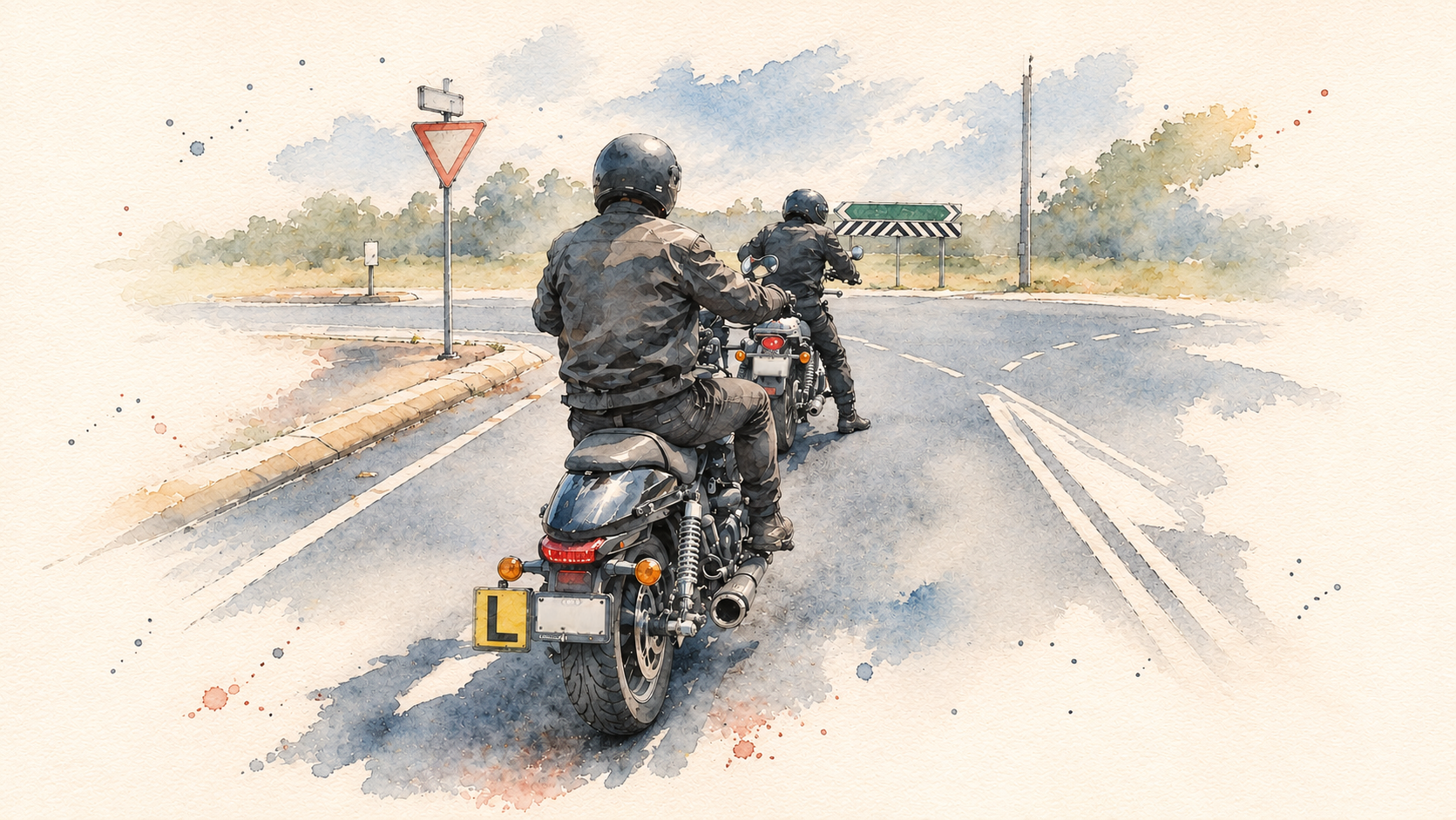
A learner is invited along on a ride with their supervisor and a group of experienced riders.
Sounds great, doesn't it? A chance to get some kilometres under their belt.
But what happens when the group rides faster than the learner is comfortable with?
What happens when the learner is concentrating on keeping up rather than developing their skills?
What happens when other riders start showing off, taking unnecessary risks or treating the ride like a competition?
And what happens when the supervisor becomes more interested in riding with their mates than looking after the learner?
The learner is now trying to manage motorcycle control, traffic, unfamiliar roads, group dynamics and the pressure of not wanting to hold everyone up.
That's a lot to ask of someone who's still learning.
Group riding can be enjoyable and educational when it's organised appropriately. But simply putting a learner in a group doesn't make it good training.
If you're supervising a learner, their safety and development need to come before your entertainment.
And if you're the learner, you're allowed to say, "This isn't the ride I need today."
Supervisors Should Welcome Being Questioned
Here's a challenge for those of us who supervise other riders.
If you're willing to assess a learner's skills, confidence and attitude, you should be equally willing to have your own skills, judgment and motivations assessed.
A learner asking questions isn't being difficult.
They're taking responsibility for their own safety and development.
That's something we should encourage.
Explain your approach. Listen to what they're hoping to achieve. Be clear about what you can help with.
And remember that your behaviour is teaching them something, whether you're deliberately instructing them or not.
They notice how you respond to traffic, how you approach corners, how you treat other road users and how you behave around other motorcyclists.
They notice whether you practise what you preach.
If they copied your riding habits and attitudes, would you be happy with the result?
It's a question worth asking ourselves.
Give Confidence Something to Stand On
Back to that uphill cul-de-sac.
What made that moment special wasn't simply that a learner successfully completed a manoeuvre.
It was watching her recognise that she had more ability than she'd given herself credit for.
That doesn't mean every learner should be pushed beyond their comfort zone.
Sometimes discomfort is telling us something important about the limits of our current skills.
A good instructor or supervisor needs to recognise the difference.
We should observe, listen, practise, introduce appropriate challenges and give learners the opportunity to demonstrate what they can do.
Confidence should grow alongside competence, not race ahead of it.
And when a learner achieves something they previously doubted they could manage, celebrate it.
Those moments matter.
I've been fortunate to witness several of them recently, and I reckon the riders involved deserve to feel proud of themselves.
The Rider Who Comes Next
My ambition isn't simply to help someone pass their Q-Ride assessment.
That's an important milestone, but it's not the finish line.
I want to help develop riders who are skilled, safe, thoughtful and independent.
Riders who understand their limitations, regularly practise their skills and make good decisions when nobody is watching.
And perhaps, one day, those riders will find themselves in a position to help somebody else.
Maybe they'll notice a nervous learner standing alone at a meeting point.
Maybe they'll walk over and say, "Hey, I'll ride with you. We'll go at your pace."
And hopefully they'll have the skills, patience and judgment to follow through on that promise.
That's the kind of influence I'd love to see spread through motorcycling.
Not through lectures or telling everyone else how to ride.
Through the quiet example of people doing it well.
So, to the learners: ask questions, trust your judgment and take ownership of your development.
And to the supervisors: remember what someone is trusting you with when they agree to ride alongside you.
Good supervision isn't just about helping someone become a better rider. It's about helping them become the kind of rider others can safely learn from.
Like I always tell my daughter: be safe, be smart and have fun.